
Every year, the International Journalism Festival (IJF) in Perugia brings together a couple of thousand journalists and media professionals to talk about the state of the industry. This year, on its 20th anniversary, some of the most useful conversations weren’t about journalism itself – they were about what it takes to keep journalism organisations alive.
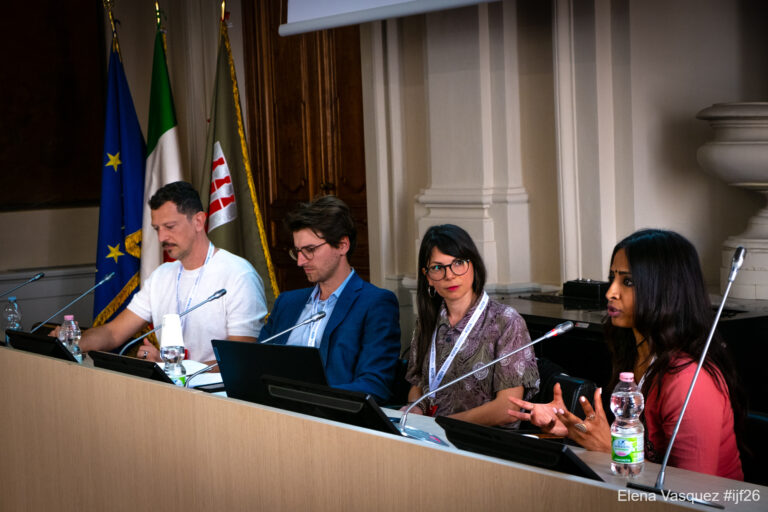
Reference Circle was part of those conversations. At a panel on building sustainable support ecosystems for independent public interest media, network director Peter Matjašič joined IRPI co-founder and Reference board member, Cecilia Anesi, Preethi Nallu from Report for the World, and Ryan Powell from the International Press Institute to dig into something the sector talks around more than it talks about: the organisational infrastructure that makes editorial work possible.
The question that cut through the room was a simple one: if you had money to invest right now, would you put it into reporting capacity or organisational capacity? The honest answer from across the panel was: both, but the second one is chronically underfunded. Most independent newsrooms are built by journalists who are brilliant at their craft and under-equipped for everything else – HR, fundraising, financial management, funder relations. That gap is where a lot of organisations quietly break.
It’s also the gap that the Reference Circle was built to help close. Not through a programme or a formal curriculum, but through peer exchange, connecting newsroom leaders across Europe who are working through the same problems in different contexts, and giving them a space to learn from each other’s experience rather than starting from scratch. Governance questions, hiring decisions, how to structure a membership model: these are things members have genuinely shaped by talking to each other through the network.
The broader conversations at Perugia this year reinforced why this kind of infrastructure matters. Across multiple panels, the same tensions surfaced: funding still flows mostly from north to south, impact is still measured by western benchmarks, and the organisations doing the hardest work in the most difficult environments are often the least resourced to navigate all of that. Regional networks and community-led models are increasingly seen as part of the answer, not because they solve the funding problem, but because they reduce isolation and build the collective capacity to tackle it.
The Reference Circle is now five years old. It’s still growing, still figuring out what shared services across the network could look like, still reminding members to actually use the almost bottomless well of resources the group provides. But the direction is clear: independent journalism needs more than grants. It needs the organisational conditions to survive them – and each other.