
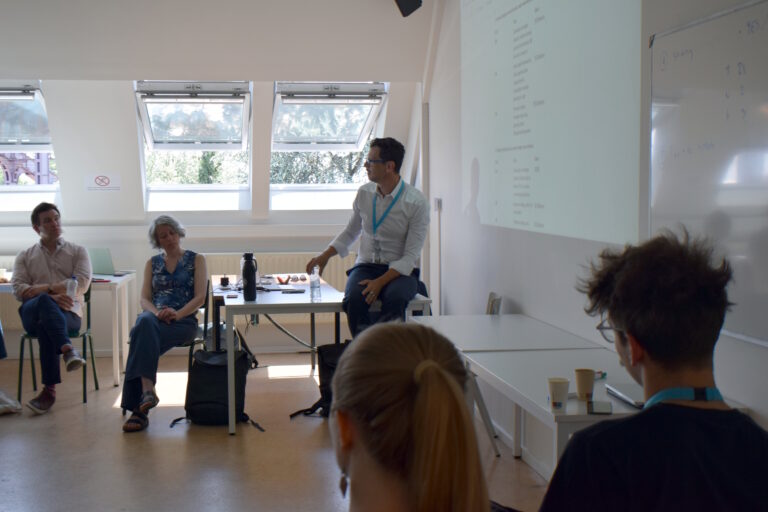
Mechelen was always going to be a big meeting. Last month, the Reference Circle gathered in Belgium’s Flanders region for its annual Spring Meeting, and left with decisions that will shape the network for years to come. By the time over two thirds of member organisations sat down together at Thomas More Campus on May 28th, there was a sense in the room that what was being decided that day wasn’t just procedural – it was foundational.
Hosted on the sidelines of Dataharvest, the meeting brought a full day of governance work embedded within a series of informal chats, catch-ups and community building.
From informal network to formal organisation
The Reference Circle was never designed to be a bureaucratic structure. Since 2021, it has grown as something rarer, a genuinely peer-driven network of independent newsrooms that trust each other enough to build together. Over five years, that trust has translated into real collaboration: joint bids, peer learning, shared editorial infrastructure, and honest conversations about what public-interest journalism needs to survive.
But ambition eventually requires architecture. The network’s goals, which include advocacy for independent media, structured knowledge exchange, and potentially re-granting to member organisations, need a legal home that can hold them. That’s what the meeting in Mechelen was about.
The vote
Members had been working towards this decision since September 2025, when the spin-off process formally began. A task force drawn from the membership met three times over the following months, worked through the legal options with pro-bono support, and brought clear recommendations to the general assembly: register in the Netherlands as either a stichting or a vereniging.
The discussion before the vote was substantive. Members drew on their own institutional experience, raised practical concerns about governance and accountability, and pushed for clarity on how member voice would be preserved under the new structure. It was exactly the kind of conversation Reference Circle is built for.
When it came to the vote: the stichting carried with a notable majority.
Members then turned to the supervisory board. Four models were debated across two rounds of voting, and the membership chose a structure comprising three members of the G5 plus two external advisors, a deliberate balance between elected representation and outside expertise.
Two new members
Mechelen also marked the formal admission of two new organisations. Vers Beton, based in Rotterdam, is a city-level newsroom funded by its readers and focused on independent local reporting in the public interest. Long Play, from Finland, is journalist-owned and reader-funded, with over a decade of long-form investigative and environmental journalism, and the distinction of being Reference Circle’s first Nordic member.
Their admission brings the membership to thirty-five. More importantly, they bring skills and perspectives the network will draw on: deep audience relationships, membership expertise, and hard experience of making independent journalism financially sustainable.
What follows
The stichting registration is now underway, led by Network Director Peter Matjašič and the incoming G5. Reference Circle has spent five years proving that independent newsrooms are stronger together. The decisions taken in Mechelen are about making sure that remains true for the next five.